
The ODSE Test Explained
11 April 2026
The Owners and Directors Test: What's Changed and Why
The ODSE test for football clubs is already in force. It came into effect on 12 December 2025, making it the first element of the IFR's new regulatory regime to become operational (Morgan Lewis, 2026). If your club has not yet assessed its exposure, it should.
This is not the owners and directors test that clubs have lived with under the Premier League or EFL. It is substantially more demanding, broader in scope, higher in standard, and continuous in its application. Understanding what has changed, and what it means in practice, is essential for anyone who owns, chairs, or leads a regulated football club.
What the ODSE Test for Football Clubs Replaced, and Why the Old Regime Failed
Before the Football Governance Act 2025, owners and directors tests were operated separately by the Premier League, EFL, and National League. Each set its own criteria, and the tests applied primarily at the point of a new ownership or appointment. Once approved, an individual faced limited ongoing scrutiny.
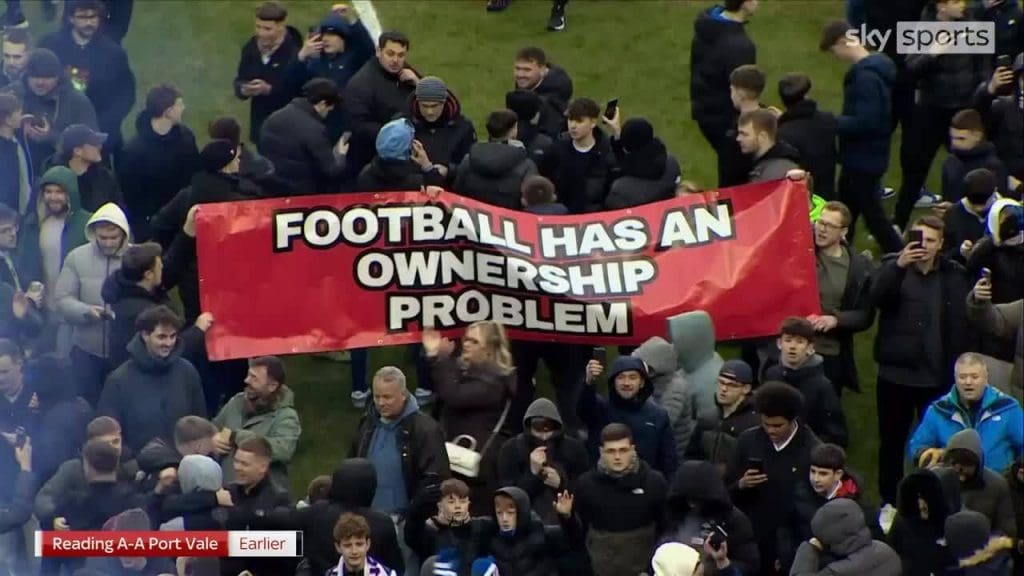
The result was a fragmented, inconsistently enforced system that was unable to respond swiftly when an existing owner's circumstances changed. The cases of Derby County, Bury, Reading, and Macclesfield, where financial collapse unfolded while governance frameworks were demonstrably inadequate, illustrated the limits of self-regulation (Lewis Silkin, 2026).
The IFR's ODSE test was designed explicitly to close these gaps.
What the new ODSE test covers
The ODSE test applies to two categories of individual:
- Owners: Defined broadly to include any person who holds more than 25 per cent of the shares or voting rights in a regulated club, or who otherwise exercises significant influence or control. This can apply indirectly, through companies, trusts, or similar arrangements. The statutory guidance on this definition has been published separately by the Government (HM Government, 2025).
- Senior Managers: Those who perform one of six defined Senior Management Functions (SMFs). The list of SMFs is set out on the right.
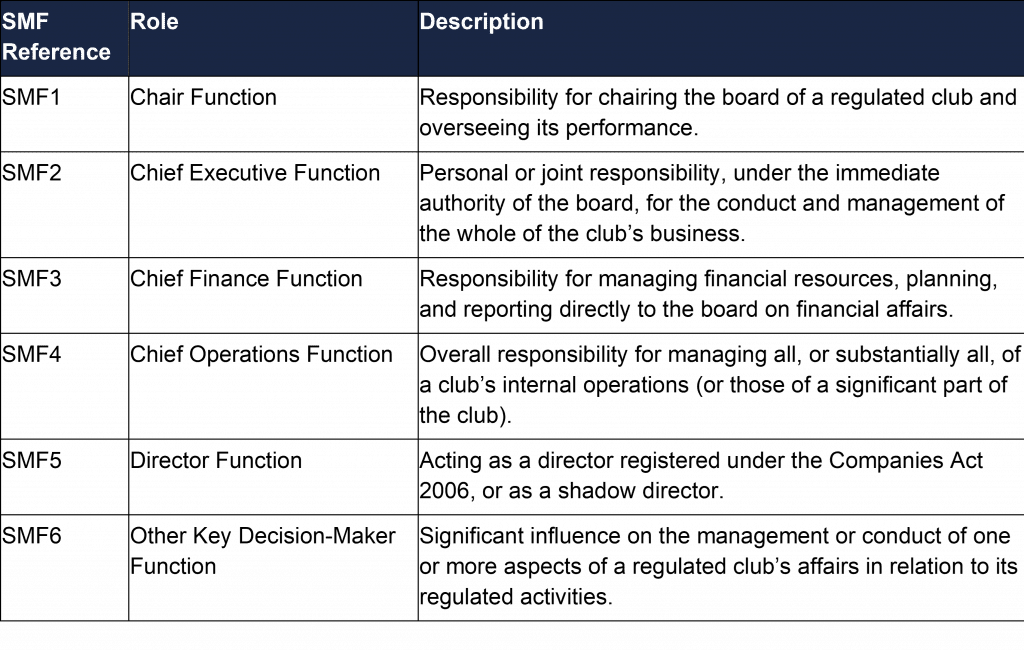
The test is function-based, not title-based. The IFR’s published guidance is explicit that an individual will be considered a senior manager if they fulfil the function set out above, regardless of their formal job title (Morgan Lewis, 2026; Lewis Silkin, 2026b). This matters in football. A Sporting Director with executive authority over significant aspects of a club’s regulated activities is a plausible SMF6, and external legal commentary has used precisely this example. A Head of Football Operations with overall responsibility for managing all or substantially all of a club’s internal operations could be SMF4. A Head Coach who sits on the Board is SMF5. The test follows the function, not the title.
The SMF framework closely mirrors the Senior Managers regime that the FCA introduced for financial services firms, deliberately so. Richard Monks, the IFR’s Chief Executive, was responsible for creating the FCA’s equivalent regime. The IFR has also signed a memorandum of understanding with the FCA to support information sharing and cooperation (Lewis Silkin, 2026c).
What has actually changed: the three biggest shifts
- Higher standards, more positions in scope. The IFR’s test assesses honesty and integrity, financial soundness, and competence. Competence includes whether an individual has the necessary skills and experience to carry out their role effectively. The regime now applies to a larger group of individuals than previous tests: owners under a broader definition, plus six categories of senior managers whose decisions shape a club’s financial health, governance, and conduct (Independent Football Regulator, 2025).
- Continuous assessment, not just point-in-time approval. For incumbents, people already in the role, the IFR can investigate and take action at any time if it has grounds for concern. The test is not taken once and forgotten. Clubs and individuals must notify the IFR when there is a 'reasonable prospect' that someone will become an owner or step into an SMF role (Morgan Lewis, 2026).
- Real enforcement powers behind it. If the IFR determines that an individual is unsuitable, it can issue a disqualification order preventing them from holding any ownership or SMF role at any regulated club. In the most serious cases, it can direct a club to remove an owner. These are statutory powers, not recommendations (Football Governance Act 2025).
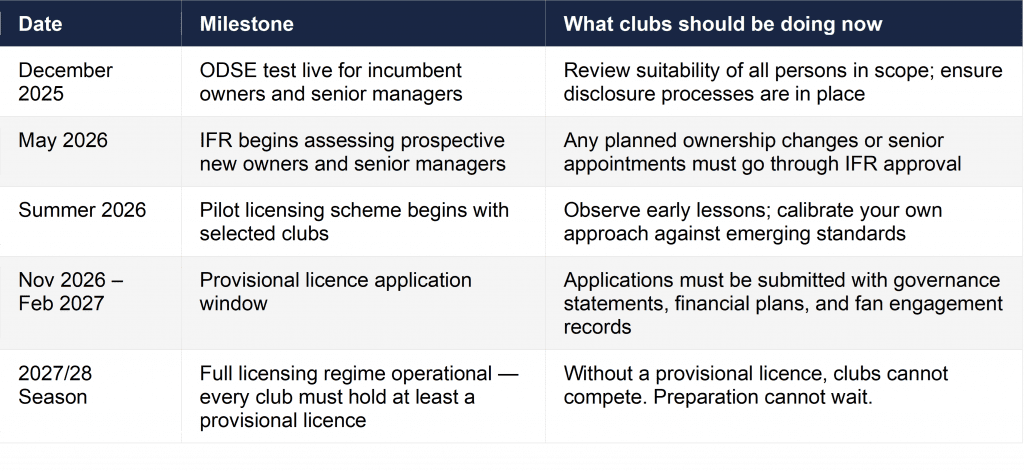
The ODSE test applied to incumbent owners and senior managers from 12 December 2025. Assessments for prospective new owners and senior managers will begin in May 2026. The IFR has 90 days to make a determination on a new application, extendable by up to 60 days in complex cases, a total of up to 150 days.
The key dates, and what they mean in practice
What this means for clubs in practice
The immediate priority is to understand who within your club falls within the scope of the ODSE regime. Two separate populations need to be mapped.
For owners, the question is who holds more than 25 per cent of shares or voting rights, and who else exercises significant influence or control. Informal influence counts. Indirect holdings through companies or trusts count. The definition is deliberately broad.
For senior managers, the question is who performs each of the six SMFs at your club, irrespective of formal titles. Some are obvious. The Chair is SMF1, the Chief Executive is SMF2, the Chief Financial Officer is SMF3. Others require more careful thought. Who has overall responsibility for managing all or substantially all of your club’s internal operations? That person is SMF4. Who acts as a director, including any shadow directors? They are SMF5. Who has significant influence over the club’s regulated activities without sitting on the board, perhaps a Sporting Director, a Group CFO acting across multiple club entities, or a senior figure who routinely directs decisions? They may be SMF6.
Clubs should also review their HR and governance processes. Employment contracts, offer letters, and promotion processes should reflect the ODSE obligations. Individuals should be required to make ongoing disclosures of changes to their personal circumstances, including criminal proceedings, regulatory action, and financial difficulties, on an ongoing basis rather than just at appointment (Lewis Silkin, 2026b).
For clubs planning ownership changes or senior appointments, the timeline implications are significant. A determination can take up to 150 days. Clubs that do not build this into their planning will face delays and complications at critical moments.
Finally, the ODSE test is not just a personal compliance matter for those subject to it. It is a governance matter for the club as a whole. The board is responsible for ensuring that the right processes are in place and that anyone whose circumstances may give the IFR cause for concern is identified and proactively managed.
The broader message
The ODSE test is the most tangible signal yet that football governance has entered a new era. The regulator has the tools, the powers, and the personnel to act. Clubs that engage openly, identifying and managing issues before they become regulatory concerns, will build the kind of relationship with the IFR that earns lighter supervision over time.
Those who take a passive approach, waiting to see what the IFR does before engaging seriously, face a materially greater risk.
Unsure whether your club's governance and personnel are ready for the ODSE regime?
Download our free IFR Governance Readiness Self-Assessment — a structured, domain-by-domain diagnostic.
Related content
- Blog: What is the IFR and Why Does It Matter?
- Blog: Licensing 101: Understanding Provisional and Full Licences
- White Paper: From City to Stadium — What Football Can Learn from Financial Services Regulation
- White Paper: If You Cannot Evidence It: Building Governance Records That Stand Up to Regulatory Scrutiny
References
Football Governance Act 2025. London: HMSO. Available at: https://www.legislation.gov.uk/ukpga/2025/21
HM Government (2025) Football Governance Act 2025: Statutory guidance on the meaning of 'significant influence or control'. London: DCMS. Available at: https://www.gov.uk/government/publications/football-governance-act-2025-statutory-guidance-on-the-meaning-of-significant-influence-or-control
Independent Football Regulator (2025) IFR regime to shut out rogue owners and promote sound investment in football. Available at: https://www.gov.uk/government/news/ifr-regime-to-shut-out-rogue-owners-and-promote-sound-investment-in-football
Lewis Silkin (2026a) Football Club Owners Take Heed: Inside the IFR’s New Owners, Directors and Senior Executives Test, 3 February. Available at: https://www.lewissilkin.com
Lewis Silkin (2026b) Football Club Senior Managers Beware: Inside the IFR’s New Owners, Directors and Senior Executives Test, 3 February. Available at: https://www.lewissilkin.com
Lewis Silkin (2026c) Implementing an effective, powerful but proportionate regime: the Independent Football Regulator is inspired and supported by the Financial Conduct Authority, 3 March. Available at: https://www.lewissilkin.com
Morgan Lewis (2026) Football Governance: New Rules for Owners and Directors of Regulated Football Clubs, 4 February. Available at: https://www.morganlewis.com/pubs/2026/02/football-governance-new-rules-for-owners-and-directors-of-regulated-football-clubs