
When Policy Meets Practice, Does Your Organisation Hold Up?
Argus Pro Assess

Regulators expect that when obligations change, people respond correctly, not just that training was delivered. Argus Pro Assess closes the gap between what policies require and what your people actually do, through scenario-based capability assessments that are targeted, proportionate, and tied directly to regulatory change.
The Problem
Regulatory Risk Thrives in the Gap Between Training and Action.
Organisations invest heavily in compliance training, yet regulators continue to identify the same failures. This isn’t due to a lack of policies or training completion, but rather the gap between training and real-world application.
Research indicates that individuals forget up to 70% of training content within a day and up to 90% within a week. Long, one-time training sessions fail to bridge this gap, as knowing something in theory differs from applying it at work.
Regulators, such as the FCA and FinCEN, now require firms to demonstrate that staff can effectively interpret and act on compliance obligations in practical scenarios, with heightened enforcement observed in 2025 and early 2026.
70%
of training content is forgotten within 24 hours (Ebbinghaus, forgetting curve).
45%
of FCA Final Notices in 2021 cited deficiencies in firms' training programmes.
1 in 3
UK law firms found non-compliant with AML regulations in 2024/25 (SRA).
What Recent Enforcement Tells Us
In 2024, TD Bank was fined USD 3.09 billion for failing to identify suspicious transactions, with staff allegedly facilitating money laundering. Santander UK faced a £107.7 million fine due to staff's inadequate knowledge despite training, while Standard Chartered was fined £102 million for failing to apply AML controls at its UAE branches.
In July 2025, Monzo was fined £21.1 million for financial crime control failings as its rapid growth outpaced staff capability and governance. Barclays received a £39.3 million fine that same month for failing to act on alerts related to a high-risk corporate relationship.
In February 2026, J.P. Morgan was fined €12.2 million for misreporting long-term risk, and Crédit Agricole was fined €7.6 million for failing to meet a climate risk assessment deadline, highlighting capability gaps across various risk domains.
The UK’s Failure to Prevent Fraud offence took effect on 1 September 2025, making large organisations criminally liable if they cannot prove effective fraud prevention measures. The key issue is not just training volume but how well it translates into practical application, as conventional training methods are insufficient to address these problems.
What is Argus Pro Assess?
Scenario-Based Capability Assessments, Tied to Regulatory Change
Argus Pro Assess - Powered by Traverse - is not a training platform. It does not deliver content or issue completion certificates. It evaluates whether your people can apply what your policies require, in realistic, role-relevant scenarios built around the obligations that actually apply to them.
When a regulatory change creates a new obligation, whether in anti-financial crime, cybersecurity, or operational resilience, Argus Pro Assess translates that change into targeted, scenario-based capability assessments for the specific teams and roles affected. The result is a clear picture of organisational readiness at the role, team, and firm level, presented in a format that compliance leaders and boards can use with confidence.
This is not about testing knowledge in isolation. It is about testing the ability to interpret and act in conditions that mirror real working situations. The difference matters. A relationship manager who can answer an AML quiz is not the same as one who recognises a red flag, understands the escalation path, and takes the right action under time pressure.
Realistic Scenario Design
- Scenario-based capability assessments built around real working situations
- Role-specific, not generic
- Reflects the decisions your staff actually face
- Designed for Anti-Financial Crime, Cybersecurity, Operational Resilience, AI Governance, and ESG obligations
Structured Data Capability
- Results reported at the individual, role, team, and firm levels
- Clear view of where capability is strong, and where it needs attention
- Tracks progress over time
- Supports proportionate, targeted intervention
- Capability to test-and-grade, as well as practice-and-improve
Defensible Outcomes
- Demonstrates that people can apply what they have learned, not just that they have attended a training course
- Provides a clear line of sight from regulatory change to staff capability
- Structured output for compliance leaders, boards, and governance committees
- The grading process is granular and 'glass-box', therefore auditable
PayPath: A Crypto Onboarding Case Under Pressure
In this video, we follow a Junior Compliance Officer at a fictional payments firm as they navigate a rigorous assessment of their technical KYC knowledge.
The evaluation delves deep into the application of critical policy sections and tests their ability to withstand commercial pressure. Furthermore, it challenges them to recognise when a case has escalated beyond their authority.
This isn't just a theoretical exercise; it's a real-world scenario that highlights the essential skills and decision-making capabilities that a simple training certificate can't capture.
The stakes are high, and the insights gained here are invaluable for anyone in the compliance field.
The Ecosystem
From Regulatory Change to Demonstrated Capability: One Continuous Loop
Argus Pro Assess - Powered by Traverse - does not operate in isolation. It connects into a continuous compliance loop across three integrated platforms. Each platform builds on the last, and the cycle begins again each time a regulatory change requires a response. Together, they give compliance leaders a complete line of sight from the moment obligations change through to the point where your people can demonstrate they can act on them.
NexEdge™
Regulatory Change Detection
Monitors legislation, regulation, and guidance across jurisdictions. Interprets what has changed, determines what it means for your policies and controls, and flags any gaps that may have been created. Material changes flow to the assessment and people layers.
Aegis Compass™
Maturity & Effectiveness
Structured compliance assessment frameworks across anti-financial crime (AFC), cybersecurity & digital operational resilience (CDOR), AI Governance, and ESG. Measures both process maturity and process effectiveness. Provides a baseline against which NexEdge™ evaluates new regulatory changes, so you know exactly what any new updates mean for you.
Argus Pro Assess™

Capability Demonstration
Translates regulatory changes and identified gaps into targeted, scenario-based capability assessments for the specific people and roles affected. Confirms that your staff can interpret and apply the rules, not just that they have received the training.
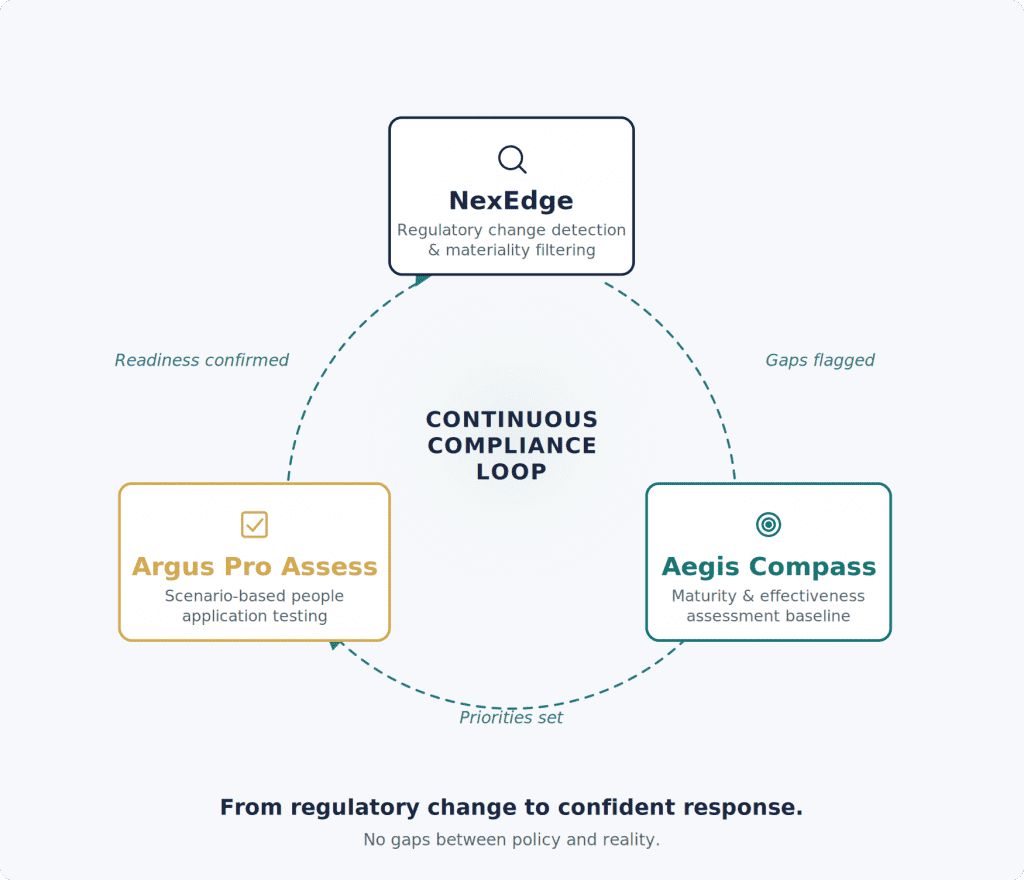
Together, these three platforms create a continuous loop: from detecting what has changed, to understanding what it means for your controls, to confirming that your people can apply it in practice. The loop then resets; each new regulatory development feeds back into the cycle. No gap between policy and reality. No reliance on training completion as a proxy for competence.
How it Works
From Baseline to Targeted Response
Argus Pro Assess - Powered by Traverse - operates within a continuous compliance loop. The process begins with an understanding of your current position, monitors how regulatory change affects it, and then identifies specifically where staff capability needs to be confirmed or strengthened. The cycle is triggered by what changes, not by an annual calendar.
1
Baseline Assessment
Aegis Compass hosts our compliance frameworks and enables a full maturity and effectiveness assessment across the domains relevant to your organisation. The assessment identifies specifically what needs attention, why, and in which domains, producing a clear, structured baseline against which all subsequent activity is measured.
2
Monitor & Flag Gaps
NexEdge™ monitors legislation, regulation, and guidance across jurisdictions in real time. Each new LRG update is checked against the original instrument in our library. If an update creates a new control objective, a regulatory expectation not addressed by your existing controls, NexEdge™ flags this as a material gap. Not every change creates a material gap. NexEdge™ filters for what genuinely requires a response.
3
Policy Gap Analysis
Alongside the control-level check, our AI capability performs a parallel review: does the regulatory update create a gap in your existing policies that requires additional wording or a new policy to bridge it? Where it does, PolicyBridge™ surfaces suggested policy text changes for your relevant teams to review. The output is specific: ‘This update now requires firms to do X, and based on your existing policies, this means you’ll need to either a) add wording to Policy Y or b) create a new Policy.’
4
Targeted Alert
The specific teams and roles whose responsibilities are affected by the change are identified and alerted. Alerts are not broadcast across the firm. They are targeted at the people who need to act, and they explain what has changed, what it means for their role, and what needs to happen next.
5
Capability Assessment
Argus Pro Assess - Powered by Traverse - translates the identified gap into a realistic, role-relevant scenario-based capability assessment for the affected staff. This overcomes what is sometimes called the ‘messy middle’, the point at which the response is calibrated: some changes require full training, assessment, and demonstrated capability; others require targeted communications or a light-touch intervention. Results are reported at the role, team, and firm levels, giving compliance leaders a structured view of organisational readiness and a clear basis for further action where needed.
Proportionate by Design
How the Response Is Calibrated: The Messy Middle
Not every regulatory change requires a full training programme, a firm-wide assessment, and a formal demonstration of capability. One of the most common sources of compliance fatigue is the tendency to apply the same response to every update, regardless of the actual risk involved. That is costly, disruptive, and often counterproductive.
The so-called "messy middle" is the practical challenge of deciding what genuinely requires a people response, and what kind. Once NexEdge™ identifies a material gap and the policy analysis confirms that staff need to do something differently, the question becomes: how significant is that change, and what level of intervention does it warrant?
The distinction between these tiers is not made by an algorithm alone. Domain experts in anti-financial crime, cybersecurity, operational resilience, AI governance, and ESG review material changes. They identify which require training, policy updates, notifications, or formal assessments. A governance layer then signs off on what reaches people, balancing policy intent, risk appetite, and operational reality. These decisions feed directly into the learning and assessment planning cycle.
Demonstrating Readiness
What Regulators Expect, and How the Ecosystem Delivers It
Regulators are not expecting perfection in real time. They expect firms to know what has changed, respond in proportion to the risk, and show that their people can actually apply the rules.
The FCA has made clear that “inadequacy of training for staff” is a recurring weakness in enforcement actions. FinCEN noted in the TD Bank case that management “failed to properly ensure that the requisite employees received appropriate training”, not training in name, but training that equipped staff to act. MAS, APRA, the RBI, and the CBUAE have all issued similar findings across their respective jurisdictions.
What regulators consistently ask for is a line of sight: a clear, traceable path from a regulatory change through to the point where a specific person, in a specific role, has demonstrated that they understand and can apply that change in practice. That is exactly what the Argus Pro ecosystem provides.
The Complete Line of Sight
1
LRG Change
A specific regulatory change is detected and classified by jurisdiction, product type, and business area.
2
Policy Update
The change is mapped to the specific policies and controls it affects. Gaps are identified, and policy text is updated for review.
3
People Identified
The teams and roles affected by the change are flagged. Only those who need to act are alerted.
4
Assessment Delivered
Realistic, scenario-based assessments are deployed to the relevant staff at the right time and cadence.
5
Capability Data
Transparent ("glass-box") and granular grading, together with structured results at the individual, role, team, and firm levels, are presented in a format that compliance leaders, governance committees, and boards can use to demonstrate organisational readiness.
A Different Approach
Why Conventional Compliance Training Has a Structural Weakness
Most compliance training is designed to demonstrate that a course was attended, not that anything changed as a result. The limitations are well documented by regulators, by behavioural scientists, and by the outcomes of enforcement actions around the world.
Conventional Compliance Training
|
Measures completion, not competence |
|
Generic, one-size-fits-all content |
|
Once-a-year delivery, rapidly forgotten |
|
Pass/fail knowledge quiz at the end |
|
Output: a completion certificate |
|
No link to regulatory change |
Argus Pro Assess
|
Measures whether staff can apply what they know in realistic situations |
|
Role-specific scenarios tailored to actual responsibilities |
|
Scheduled to match regulatory cycles and operational cadences |
|
Structured capability results by individual, role, team, and firm |
|
Output: a clear view of organisational readiness for boards and compliance leaders |
|
Triggered by material regulatory changes that directly affect your people |
Built for Senior Compliance Leaders
Benefits for Compliance Leaders
Clarity on Readiness
- Know where capability is strong and where gaps exist
- Results at the role, team, and firm levels
- Clear priorities for targeted intervention
- Track progress across assessment cycles
Proportionate Response
- Only material regulatory changes trigger assessments
- Right people alerted, not whole departments
- Tiered approach avoids fatigue and unnecessary cost
- Governed by expert oversight, not automated rule-sets
Confidence at Board Level
- Clear, structured output for governance committees
- Traceable line from regulation to demonstrated capability
- Supports meaningful board-level discussion on compliance risk
- Reduces reliance on completion data as a performance measure
For Chief Compliance Officers & MLROs
Move beyond training records as a measure of compliance health. Argus Pro Assess - Powered by Traverse - gives you a structured, repeatable view of whether your people can actually do what the regulations require, and a clear path to address it when they cannot.
For Boards & Risk Committees
Receive structured capability data, not just a training dashboard, that supports meaningful oversight of compliance risk. Understand where your organisation stands and where it needs to improve, in language that makes sense at the board level.
Built for Regulated Organisations and the Leaders Responsible for Compliance
By Sector
- Banking & Financial Services (retail, investment, private, payments, e-money, fintech)
- Insurance & Reinsurance
- Professional Services (accountancy, consultancy, corporate services)
- Legal (law firms, in-house legal, trust and company service providers)
- Crypto & Digital Assets
- Any sector subject to anti-financial crime, cybersecurity, ESG, AI Governance, and operational resilience obligations
By Role
- Chief Compliance Officers and MLROs
- Chief Information Security Officers
- Heads of Financial Crime, Risk, and Operational Resilience
- Chief Risk Officers and General Counsel
- Boards, risk committees, and non-executive directors
- Heads of Learning & Development responsible for compliance curriculum
Frequently Asked Questions
Is Argus Pro Assess the same as a training platform?
No. Argus Pro Assess - Powered by Traverse - is not a training platform; it is a capability assessment platform. It works alongside your existing training function to test whether staff can apply what they have been taught in realistic situations. The scenario-based assessments do not deliver training content. They tell you whether the training has worked.
Does this replace our existing compliance training?
No. Argus Pro Assess - Powered by Traverse - complements your training programme; it does not replace it. Think of it as the capability layer that sits above training: confirming whether staff can act on what they have learned, rather than simply whether they completed the course.
Do we also need to use NexEdge and Aegis Compass?
Argus Pro Assess - Powered by Traverse - is part of the Argus Pro ecosystem and is designed to work alongside NexEdge™ and Aegis Compass™ for the most complete compliance loop. However, we can develop bespoke assessment capabilities for your organisation. Contact Argus Pro to discuss your specific situation.
What frameworks does Argus Pro Assess cover?
Argus Pro Assess - Powered by Traverse - will initially support anti-financial crime (AFC) and cybersecurity and digital operational resilience (CDOR) capability assessments, reflecting our existing framework coverage. AI Governance and ESG capability assessments will follow as these frameworks are launched.
What do the assessment outputs look like?
Results are structured at the role, team, and firm level. Compliance leaders receive a clear view of where capability is strong and where it needs attention, along with a traceable path from the triggering regulatory change through to the specific people assessed. Outputs are designed to be meaningful in governance and board-level reporting.
Is Argus Pro Assess an audit or an assurance service?
No. Argus Pro is not an auditor, and its platforms and frameworks are not audits. Argus Pro does not provide audit or assurance services, audit or legal opinions.
Argus Pro Assess - Powered by Traverse - is a capability assessment solution that provides structured data on how well staff can apply compliance obligations in realistic scenarios. Any use of that data for external reporting purposes is a matter for your compliance function and relevant advisers.