
IFR Provisional Licence
11 April 2026
Licensing 101: Understanding IFR Provisional and Full Licences
The IFR provisional licence for football clubs is not optional. From the 2027/28 season, every club in the top five divisions of men's football must hold an operating licence issued by the Independent Football Regulator (IFR). Without one, a club cannot compete. This is a statutory requirement under the Football Governance Act 2025.
The application window for provisional licences opens in November 2026 and closes in February 2027. That gives clubs less than 18 months from now to put the right foundations in place. For many clubs, that is not as long as it sounds.
What is an IFR Provisional Licence for Football Clubs?
All 116 regulated clubs will need a provisional license starting in the 2027/28 season. Clubs that cannot show they meet full license standards will apply for this entry-level license first.
To obtain a provisional license, clubs must meet mandatory conditions across four areas. First, they need financial sustainability, demonstrating sound resources and a solid financial plan. Additionally, they must show evidence of resilience under stressful scenarios, like relegation.
Next, corporate governance is essential. Clubs must comply with the Football Club Corporate Governance Code and publish a governance statement.
Moreover, owner and director suitability matters. They must confirm that individuals subject to the Owners, Directors, and Senior Executives test meet the required standards.
Finally, fan engagement plays a significant role. Clubs should establish processes for meaningful consultation with supporters, especially on heritage matters.
The provisional license can remain valid for up to three years. During this time, clubs must show ongoing compliance and work toward achieving a full license (Pinsent Masons, 2025).
Applying for an IFR provisional licence is not simply a matter of submitting paperwork. The IFR will assess the quality and credibility of the submissions. Clubs that submit governance statements that describe intended rather than actual practice, a common problem in financial services regulation, will find the process more difficult.
What is a Full Licence?
A full licence replaces the provisional licence. This change signals that a club has shown sustained compliance with the IFR's mandatory conditions. It also indicates that the club operates under the governance and financial standards the regulator expects continuously.
The transition from provisional to full licence takes time, and this is intentional. The IFR does not seek perfection at the initial application. Instead, it looks for clubs that grasp their current situation. These clubs need to address gaps honestly and build the internal discipline necessary to track their progress over time.
This approach aligns with how the Financial Conduct Authority supervises financial services firms. By investing early in genuine governance improvements, clubs can earn lighter-touch supervision in the long run. Consequently, clubs that achieve full licence status quickly will not only satisfy the regulator. They will also become better-governed organisations (Independent Football Regulator, 2025).
What if a club does not have a licence?
A club without at least a provisional licence cannot participate in any of the specified competitions from the 2027/28 season. The IFR has made clear that it will take a proportionate, risk-based approach, but proportionality does not mean leniency for clubs that have not engaged with the process.
The IFR's enforcement powers are significant. In serious cases, it can suspend or revoke a licence, impose financial penalties, or issue directions requiring specific remedial action. The regulator has indicated it will seek to work constructively with clubs that engage openly, but the tools to act firmly are in place (Football Governance Act 2025).
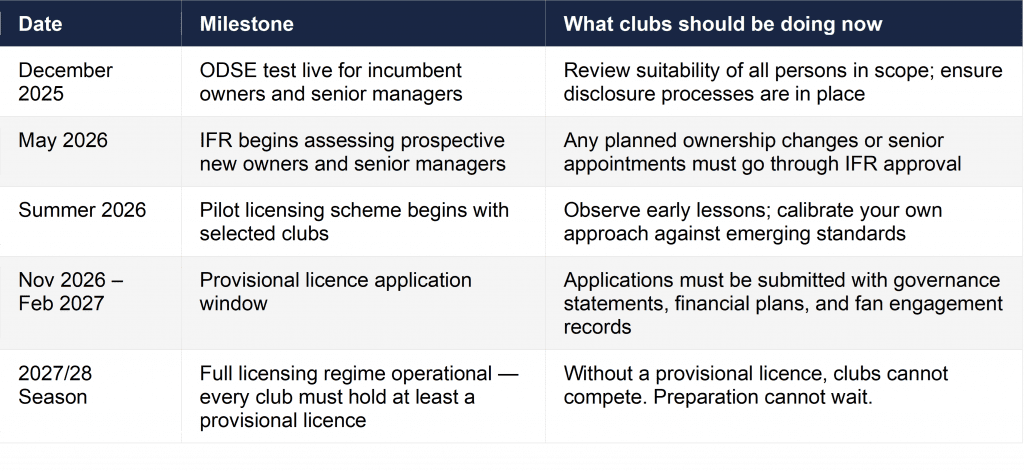
The key dates, and what they mean in practice
What should clubs be doing now?
Most clubs entering the IFR regime currently struggle to understand what is required. They often find four common areas where gaps appear. These gaps can be costly to address at short notice.
- First, financial planning documentation needs improvement. The IFR expects clubs to create forward-looking financial plans. These plans must include realistic assumptions and sensitivity analysis. Additionally, evidence of board-level challenge is crucial. A single base-case budget will not suffice.
- Second, governance records require better detail. Board minutes that record decisions without explaining the reasoning behind them are weak. The IFR seeks documentation that captures the decision-making process, not just the outcomes.
- Next, clubs must focus on ODSE compliance. They should review the roles that fall under the ODSE test. Ensuring disclosure and monitoring processes are in place is essential. Starting from May 2026, new appointments will need formal IFR approval.
- Lastly, clubs need fan engagement mechanisms. They must establish documented processes for meaningful supporter consultation. One-off events held before a decision is made do not meet this requirement.
Clubs that approach these issues honestly will progress more quickly. By assessing their actual position, they can work toward improvement. A structured, independent assessment serves as the most efficient starting point.
Not sure where your club stands?
Download our free IFR Governance Readiness Self-Assessment — a structured, domain-by-domain diagnostic.
Related content
- Blog: What is the IFR and Why Does It Matter?
- Blog: The Owners and Directors Test: What's Changed and Why
- White Paper: From City to Stadium — What Football Can Learn from Financial Services Regulation
- White Paper: If You Cannot Evidence It: Building Governance Records That Stand Up to Regulatory Scrutiny
References
Football Governance Act 2025. London: HMSO. Available at: https://www.legislation.gov.uk/ukpga/2025/21
Independent Football Regulator (2025) Licensing Regime Consultation. Available at: https://engage.footballregulator.org.uk/licensing-regime
Independent Football Regulator (2025) Help protect the future of football. Available at: https://www.footballregulator.org.uk/help-protect-the-future-of-football
Pinsent Masons (2025) England's Independent Football Regulator. Available at: https://www.pinsentmasons.com/out-law/guides/england-independent-football-regulator
Latham and Watkins (2025) Key Elements of the Football Governance Act 2025. Available at: https://www.lw.com/en/insights/key-elements-of-the-football-governance-act-2025
Hill Dickinson (2025) The Independent Football Regulator: new era for football governance. Available at: https://www.hilldickinson.com/our-view/articles/the-independent-football-regulator-a-new-era-for-football-governance