
From City to Stadium: What Football Can Learn from Financial Services Regulation
13 April 2026
Executive Summary
The Football Governance Act 2025 marks the biggest structural change to English football since the Premier League launched in 1992. The Independent Football Regulator (IFR) brings real powers: licensing, financial scrutiny, continuous supervision, and the ability to remove unsuitable owners. IFR football governance means that, for clubs that have never faced statutory regulation, this is unfamiliar territory.
However, it is not without precedent. The post-crisis financial services sector went through exactly this transition. The parallels are instructive:
- The shift from occasional inspection to continuous oversight.
- The expectation that firms demonstrate governance effectiveness, not just compliance on paper.
- The emphasis on culture, conduct, and the sustainability of business models under stress.
Some firms adapted quickly. Others paid heavily for treating new regulation as a box-ticking exercise. The clubs that learn from that experience will navigate the IFR regime faster and at lower cost.
This white paper draws on two decades of financial services regulatory experience. It sets out six lessons that transfer directly to IFR football governance. They are practical and structured around the specific demands of the IFR regime.
KEY PRINCIPLE: Compliance on paper is not compliance. The IFR will assess what you do, not just what you say.
1. The Regulatory Paradigm Shift
In 2008, the UK financial sector learned that light-touch regulation had failed. The Financial Services Act 2012 created a new architecture: the Financial Conduct Authority (FCA) for conduct, the Prudential Regulation Authority (PRA) for systemic risk, and a philosophy of continuous, risk-based supervision.
The IFR represents the same paradigm shift for football governance. Under the Football Governance Act 2025, 116 clubs across the top five tiers of men's football face statutory regulation for the first time. The licensing framework rolls out in stages. The IFR holds wide-ranging powers:
- Granting, amending, and revoking operating licences.
- Requiring clubs to submit financial plans and governance statements.
- Investigating alleged breaches and imposing financial penalties.
- Requiring IFR approval before clubs sell, relocate, or dispose of key assets.
- Assessing owner, director, and senior executive suitability on an ongoing basis.
The Owners, Directors and Senior Executives (ODSE) regime sits at the heart of this framework. The IFR consulted on it in September 2025. Clubs should treat it as active and material. Suitability is not a one-time approval. The IFR can reassess at any time.
Many clubs have focused on immediate licensing requirements. This is understandable. However, it misses the deeper point. Financial services firms that treated post-crisis regulation as a compliance exercise found themselves repeatedly on the wrong side of supervisory expectations. Those who understood the regulator's mindset built relationships based on trust. They earned lighter-touch supervision over time.
The first lesson from financial services is this: the regulator's goal is not to catch you out. Its goal is to be confident that your organisation identifies, manages, and communicates problems effectively. The question is not whether problems occur. It is how your club responds when they do.
2. Six Lessons from Financial Services
Lesson One: Regulators Are Relationship-Based
The FCA does not operate through surprise inspections alone. It builds supervisory relationships over time. Firms that engage proactively, explain their reasoning, and communicate challenges early receive different treatment from those who disengage.
Black's (2008) influential work on principles-based regulation identifies the 'Trust Paradox'. Under a risk-based supervisory model, trust between regulator and firm is the prerequisite for the relationship to function. That trust depends on open, frank communication.
A firm that self-identifies and discloses a control gap demonstrates that its internal management systems work. A firm whose gap the regulator discovers, rather than the firm reporting it, signals the opposite. The supervisory consequences differ materially.
The IFR has adopted a clear philosophy: it expects clubs to come to it rather than wait to be found. Clubs that build a proactive relationship with their regulator will find supervision considerably less burdensome. Clear communication, early disclosure of issues, and transparent governance all reduce supervisory friction.
Lesson Two: Documentation Precedes Credibility
In financial services, the principle is simple: if you cannot demonstrate it, you cannot rely on it. Regulatory examinations do not assess what firms say they do. They assess what firms can show they do.
This distinction matters enormously in practice. A club may have excellent informal governance, sound financial management, and capable leadership. However, sparse board minutes, undocumented decisions, and unsigned policy drafts leave the IFR with limited basis for confidence.
The IFR's licensing conditions require clubs to maintain governance statements, financial plans, and records that support regulatory examination. This is not bureaucracy for its own sake. It is decision protection. Properly documented decisions can be explained and defended. Undocumented decisions become liabilities.
Lesson Three: Culture Is the Control Environment
Post-2008, the FCA shifted from focusing exclusively on rules to focusing on culture. The reasoning was clear: firms with strong, consistent governance cultures achieved better outcomes than those relying solely on controls. A sophisticated compliance system, operated by people who do not believe in it, will fail.
Ayres and Braithwaite's (1992) responsive regulation theory argues that regulatory compliance is fundamentally a social phenomenon. Rules matter. So do the norms, incentives, and leadership behaviours that shape whether rules are followed in practice.
For football clubs, the IFR will look beyond the governance statement to the culture behind it. How does the board actually make decisions? Is dissent welcomed or suppressed? Do financial concerns reach the board promptly? Is fan engagement meaningful or performative?
The tone from the top, meaning the values and behaviours modelled by the Chair, Chief Executive, and owner, will shape supervisory outcomes more than any single policy.
Lesson Four: Proportionality Is Earned, Not Assumed
A key feature of IFR football governance is proportionality. The regulator acknowledges that a National League club cannot, and should not, operate governance systems comparable to a Premier League club. Standards scale to the risk and complexity of the organisation.
Proportionality in financial services does not mean reduced expectations. It means expectations calibrated to the firm's specific risk profile. A smaller firm may need fewer policies. Those policies must be more clearly owned and consistently applied. A League Two club cannot claim proportionality as a reason to have no governance framework at all.
The firms that benefited most from proportionality invested in demonstrating they understood their own risk profile. They built controls appropriate to it. This requires self-awareness and honest internal assessment before regulators ask the questions.
Lesson Five: Stress Is When Governance Matters Most
Financial services regulation places enormous emphasis on resilience under stress. The PRA's stress testing regime requires firms to demonstrate their financial position under severe but plausible scenarios: recession, market shocks, and operational failures.
The IFR regime carries analogous expectations. Clubs must demonstrate resilience under relegation scenarios, revenue shocks, and ownership changes. The question is not just whether the club is financially sound today. It is whether it would remain so under foreseeable adverse conditions.
Clubs that have thought through these scenarios and can show their thinking to the regulator will be in a much stronger position. Presenting an optimistic base case without downside analysis is not what the IFR is looking for.
Lesson Six: Remediation Is a Regulatory Opportunity
Regulators assess firms not only on whether they have breaches but on how they respond to them. A firm that identifies a control weakness, escalates it properly, investigates thoroughly, and implements a robust remediation plan demonstrates exactly the kind of governance that builds regulatory trust.
The reverse is also true. Firms that minimise problems, implement superficial fixes, and fail to address root causes find that minor supervisory concerns escalate into formal enforcement actions.
Football clubs will make mistakes under the new regime. Some will have governance gaps identified by the IFR. What matters is not the existence of the gap. It is the quality of the response. Clubs that treat regulatory findings as opportunities to genuinely improve will build the trust that leads to lighter supervision over time.

3. Cultural Change: IFR Football Governance Beyond Systems
One of the most consistent findings from post-crisis financial services regulation is that systems without culture fail. Banks spent billions on compliance technology, policy libraries, and reporting infrastructure. Some still suffered significant regulatory failures. The underlying culture had not changed.
Football clubs face a comparable challenge. The IFR will introduce governance requirements demanding new documentation, new processes, and new reporting. The risk is that clubs treat these as administrative burdens to discharge, rather than as opportunities to genuinely improve how they run.
Genuine cultural change requires three things:
- Leadership that models the behaviour it expects. Boards and executives that treat governance as a distraction transmit that view throughout the organisation.
- Incentives and accountability structures that reward good governance rather than short-term performance alone. Where compliance appears as a cost rather than a value, it receives that treatment.
- Honest internal assessment. Clubs need to understand their actual governance position, not the position they would like to be in. This requires structured, independent perspectives that surface uncomfortable realities alongside strengths.
The Financial Stability Board's (2014) guidance on risk culture identified four key indicators of a sound risk culture:
- Tone from the top.
- Accountability
- Effective communication.
- Challenge and incentives.
These translate directly to the IFR football governance context. A club with a sound governance culture is not one with the most elaborate documentation. It is one where governance is lived, not performed.
4. The Proportionality Dividend
The IFR has been explicit that it will apply proportionality in its supervision. This echoes the FCA's own approach. The IFR calibrates supervisory intensity primarily to a club's size and competitive tier, rather than a full firm-wide risk assessment.
In practice, clubs that demonstrate strong governance and financial management will face lighter-touch supervision. The IFR has limited resources. It will focus attention on clubs that give it reason for concern. This creates a clear strategic incentive to invest in governance quality early.
The dividend compounds over time. Firms that established strong governance cultures in the years immediately following the 2008 crisis found their regulatory relationships materially less burdensome by 2015. The supervisory capital built through early governance investment translated into real operational benefit.
Strategic Insight: The clubs that invest in genuine governance now will spend less on regulatory management in five years. Those who do the minimum will spend progressively more.
Proportionality must be demonstrated, not assumed. A club cannot simply assert that its governance is proportionate to its size. It must show, through documented frameworks, board discussion records, and structured self-assessment, that it has considered what proportionate governance means for its specific risk profile and implemented it accordingly.
5. A Framework for IFR Football Governance Maturity
The financial services sector has developed a sophisticated understanding of regulatory maturity: the progression from basic compliance to genuinely effective governance. Drawing on established maturity model thinking, clubs can understand their current position and plot a clear path forward. The IFR will assess clubs along a similar spectrum, even if it does not use this language explicitly.
Regulatory maturity in the IFR football governance context breaks down across five stages:
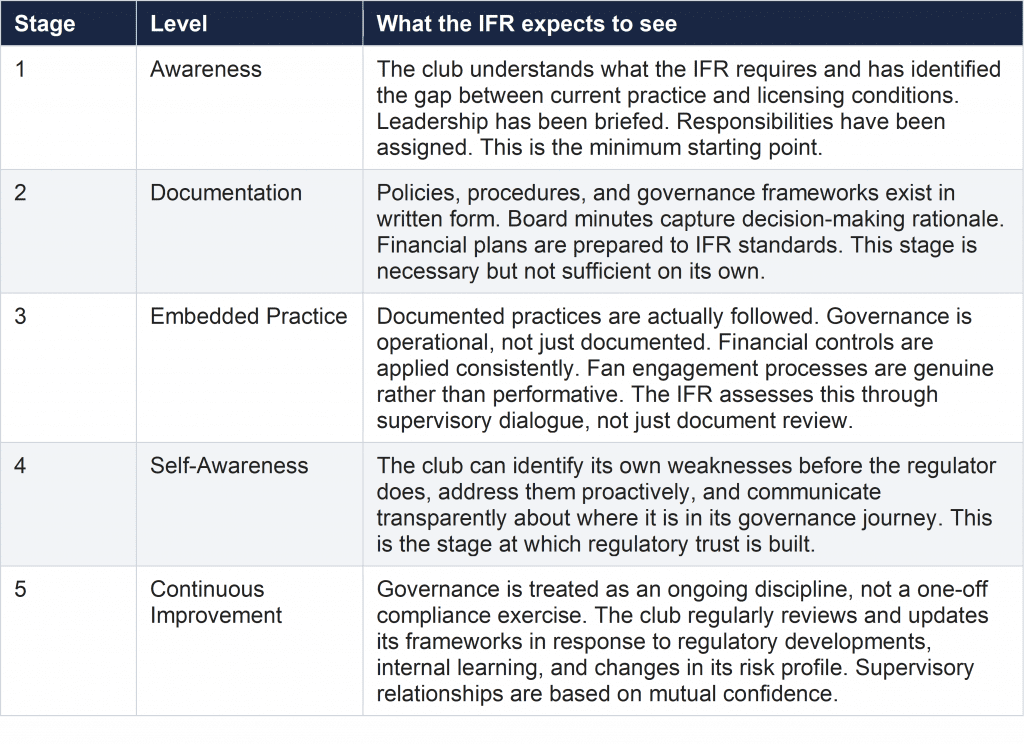
Most clubs entering the IFR regime sit at Stage 1 or early Stage 2. The licensing window and pilot scheme in Summer 2026 will test who has made genuine progress. The provisional licence application window in late 2026 will separate those who have genuinely invested from those who have not.
The clubs that reach Stages 4 and 5 fastest will not just satisfy the IFR. They will be demonstrably better-governed organisations: more resilient, more trusted by their stakeholders, and better positioned to manage the challenges all football clubs face.
Conclusion
The Independent Football Regulator brings to football exactly what post-2008 reforms brought to financial services: continuous supervision, proportionality-based assessment, and a genuine focus on culture and conduct alongside formal compliance. Personal accountability for senior leaders followed later in financial services. It crystallised in the Senior Managers and Certification Regime in 2016. The direction of travel was set from the outset.
Clubs that understand this and act on it will not just satisfy the regulator. They will build more resilient, more trusted, better-governed organisations. The lessons from financial services are clear: clubs that invest early in genuine governance improvement will benefit most over time.
The IFR does not want to find problems. It wants to be confident that your club can identify, manage, and communicate them effectively. The question is whether your club is ready to demonstrate that confidence.
Ready to assess your club's IFR football governance readiness?
Start with our free self-assessment.
References
Ayres, I. and Braithwaite, J. (1992) Responsive Regulation: Transcending the Deregulation Debate. Oxford: Oxford University Press.
Black, J. (2008) 'Forms and paradoxes of principles-based regulation', Capital Markets Law Journal, 3(4), pp. 425-457.
Financial Stability Board (2014) Guidance on Supervisory Interaction with Financial Institutions on Risk Culture. Basel: FSB.
Football Governance Act 2025. London: HMSO. legislation.gov.uk
HM Government (2025) The Independent Football Regulator: Licensing Framework Consultation. London: DCMS. gov.uk/dcms
Financial Conduct Authority (2024) Dear CEO Letter: Expectations for Firms' Financial Crime Controls. fca.org.uk