
The End of Fragmented Supervision
7 April 2026
What the FCA’s Appointment as Single Professional Services Supervisor Means for UK Law Firms.
Executive Summary
FCA AML supervision will fundamentally change the UK legal sector. On 21 October 2025, HM Treasury made a landmark announcement. The Financial Conduct Authority (FCA) will replace 22 professional body supervisors. It will act as the sole AML and counter-terrorist financing (CTF) supervisor. This change covers the legal, accountancy, and trust and company service provider sectors. For approximately 5,569 SRA-supervised law firms, this is the most consequential regulatory shift in over a decade.
This white paper examines the rationale for the change. It also sets out the legislative and operational timeline. Furthermore, it compares the SRA and FCA supervisory models. It analyses current AML compliance levels across the legal sector. Finally, it provides a structured set of recommendations for senior leadership.
The central finding is clear. The legal sector’s compliance baseline is inadequate for FCA supervision. Only 22% of law firms were fully AML-compliant under SRA supervision in 2024/25 (SRA, 2025a). The FCA issues fines in multiples that the SRA does not. As a result, preparation is not optional. And it cannot be deferred.
Key finding: Only 22% of law firms were fully compliant with AML regulations under SRA supervision in 2024/25. The sector’s compliance baseline is not adequate for the standard the FCA will apply. Preparation cannot be deferred.
1. Background: Why Fragmented Supervision Failed
1.1 The Architecture of the Old Regime
The UK’s AML supervisory landscape evolved over decades. As a result, it produced a deeply fragmented structure. At the point of reform, AML and CTF supervision was split across three layers. HMRC, the Office for Professional Body AML Supervision (OPBAS), and 22 separate professional body supervisors (PBSs) all played a role. These included the Solicitors Regulation Authority (SRA) and the Institute of Chartered Accountants in England and Wales (ICAEW) (HM Treasury, 2025a).
This fragmentation produced predictable consequences. Standards were inconsistent across supervisors. Enforcement intensity varied widely. Coverage gaps emerged at the margins. Furthermore, no body could apply data-driven, cross-sector risk analysis. OPBAS, established in 2018, had limited enforcement tools. It could only escalate to HM Treasury in cases of serious failure.
The result was a flawed system. A law firm’s quality of AML supervision depended on which body supervised it. It also depended on the resources that body chose to allocate. The SRA dedicated 30 full-time staff to AML regulation. This covered a supervised population of 5,569 firms (Lewis Silkin, 2025). That ratio is not unusual in the PBS context. However, it is qualitatively different from FCA supervision.
1.2 FATF's Assessment of the UK
The Financial Action Task Force (FATF) evaluated the UK in 2018. Its findings on professional services supervision were direct. Fragmentation undermined effectiveness. Inconsistency between PBSs created arbitrage risks. The supervisory model for legal and accountancy services was insufficiently robust (FATF, 2018).
The UK’s FATF rating reflected these concerns. The 2018 evaluation shaped domestic policy. Consequently, the October 2025 announcement explicitly frames consolidation as a FATF response. It also prepares for the UK’s next mutual evaluation, scheduled for August 2027 (Clyde & Co, 2025b). A consolidated, FCA-led regime offers a materially stronger base for that evaluation.
1.3 The 2023 Consultation and the 2025 Decision
A 2022 HM Treasury review concluded that structural reform was necessary. A public consultation in 2023 explored four models: enhanced powers for OPBAS; consolidation under a financial sector supervisor; consolidation under a legal or accountancy supervisor; and full consolidation under the FCA (HM Treasury, 2023).
The SRA proposed becoming the consolidated legal sector supervisor. It argued its sector-specific expertise made it the appropriate body (Lewis Silkin, 2025). The government rejected that argument. On 21 October 2025, HM Treasury announced the FCA as the Single Professional Services Supervisor (SPSS). The FCA will assume AML/CTF supervisory responsibility across all in-scope professional services firms (HM Treasury, 2025a).
A further consultation ran from 6 November to 24 December 2025 (HM Treasury, 2025b). It covered registration powers, fit and proper assessments, enforcement tools, and information sharing. The government’s response and enabling legislation were expected in the first half of 2026.
2. Comparative Analysis: FCA AML Supervision vs SRA
2.1 Supervisory Philosophy
The SRA developed its AML model within a culture of professional regulation. It is sector-specific, principles-based, and guidance-led. Where firms fall short, the SRA prefers guidance, engagement letters, and compliance plans. It escalates to enforcement only as a last resort.
The FCA’s supervisory model rests on different foundations. It operates within the statutory framework of the Financial Services and Markets Act 2000 (FSMA). It is data-driven, risk-stratified, and deterrence-oriented. The FCA assumes market participants respond to clear signals. Its supervisory toolkit reflects that assumption. It deploys early intervention tools proactively. It calibrates penalties to create industry-wide behaviour change.
2.2 Enforcement Powers Compared Under FCA AML Supervision
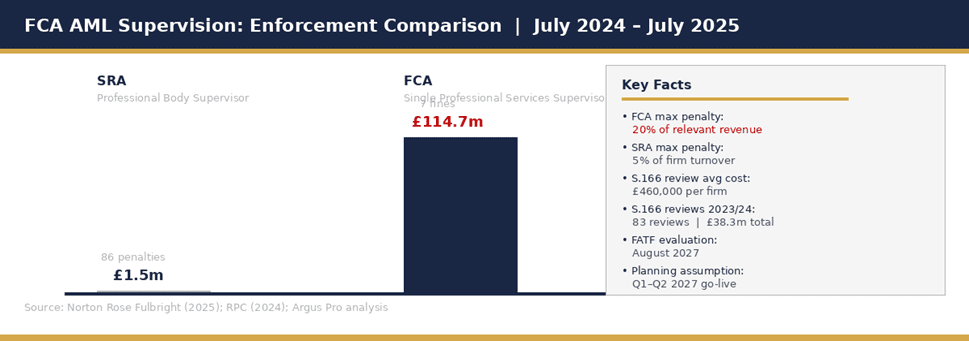
The difference in enforcement capability is significant. Between July 2024 and July 2025, the FCA issued seven fines for AML-related failings. These totalled £114.7m. In the same period, the SRA issued 86 MLR penalties totalling approximately £1.5m (Norton Rose Fulbright, 2025). The SRA can fine up to 5% of firm turnover. The FCA bases penalties on up to 20% of relevant revenue, with no effective cap.
Beyond financial penalties, the FCA’s toolkit includes tools the SRA does not possess:
- Voluntary Requirements (VREQs): binding firm-specific agreements imposing controls or restrictions. VREQ usage increased by 486% over four years preceding 2024 (WilmerHale, 2024).
- Own-initiative variations of permission: the FCA can restrict a firm’s activities without a formal investigation.
- Section 166 skilled person reviews: the FCA requires a firm to commission an independent review at its own cost. In 2023/24, 83 such reviews were commissioned. The aggregate cost was £38.3m, averaging £460,000 per review (RPC, 2024).
- Public censure: the FCA names firms and individuals subject to enforcement action.
- Criminal referrals: in serious cases, the FCA can refer matters for criminal prosecution.
2.3 The Dual Regulation Risk
One significant concern is the risk of dual regulation. The SRA will retain its professional conduct regulatory role after the FCA assumes responsibility for AML supervision. Where an AML failure also breaches the SRA’s Code of Conduct, a firm may face dual investigation. The SRA’s Code specifically requires firms to follow the law and regulation governing the way they work (paragraph 3.11) (Lewis Silkin, 2025).
How the two regulators will coordinate remains unresolved. HM Treasury’s November 2025 consultation sought views on information-sharing. However, it left operational parameters to the FCA to determine. The Law Society, the SRA, the Council for Licensed Conveyancers, and Bar Council representatives all raised dual regulation as a concern (Law Society, 2025; KYC360, 2025).
3. The Transition Timeline: An Evidence-based Analysis
3.1 Comparable Regulatory Transitions
No confirmed implementation date has been set. Therefore, law firms must extrapolate from comparable regulatory transitions. We analysed seven major UK regulatory changes. Each involved a shift in supervisory responsibility or a materially new compliance regime. The findings are instructive.
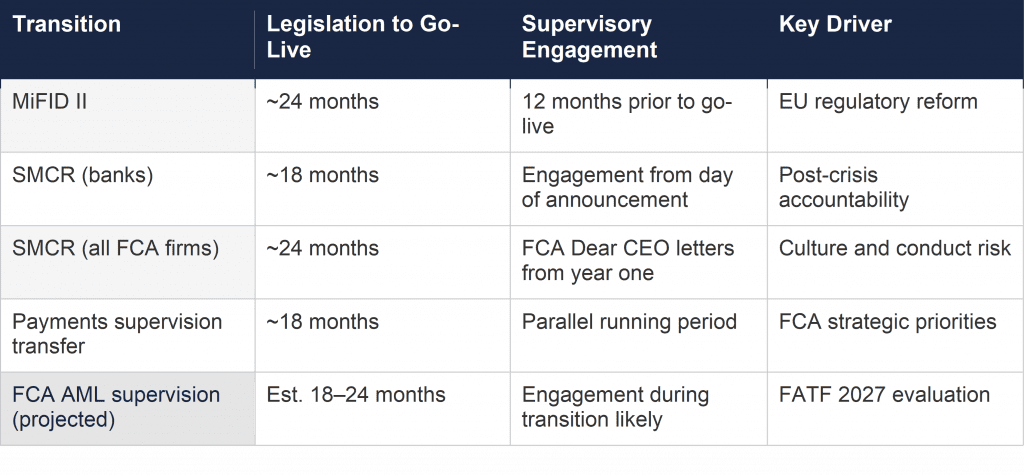
3.2 Indicative Phases for the FCA AML Supervision Transition
Applying this evidence base to the current transition produces a clear planning framework. This transition requires primary legislation. It also requires significant FCA operational build-out. Furthermore, external FATF pressure creates a credible deadline.
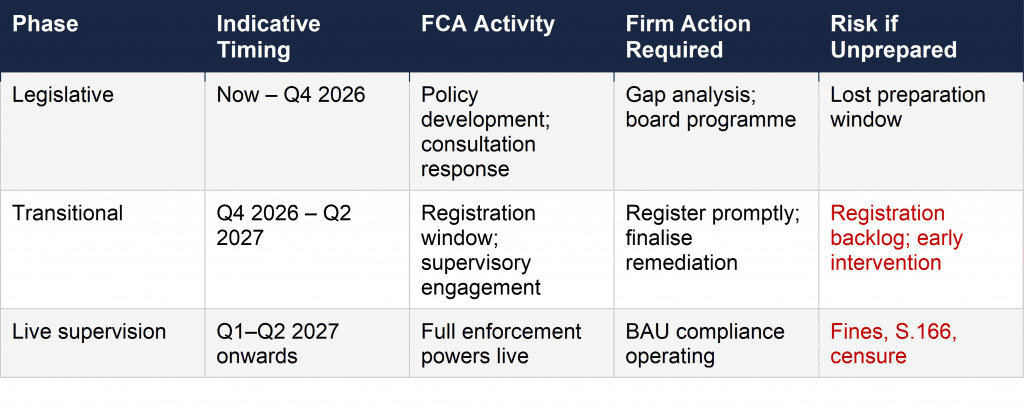
However, firms should not assume parliamentary delay provides preparation time. FCA supervisory engagement may begin during the transitional period. This can occur before formal enforcement powers are live.
4. The Compliance Gap Under FCA AML Supervision
4.1 SRA Compliance Data
The SRA’s AML annual report for 2024/25 provides the most authoritative baseline for the sector. Specifically, only 22% of law firms were fully compliant with AML regulations in 2024/25 (SRA, 2025a). This finding is material. It directly indicates the scale of preparation required for FCA AML supervision.
Moreover, the remaining 78% of firms showed at least one area of non-compliance. The FCA will not apply the SRA’s preference for guidance over enforcement. It will treat inadequate compliance as requiring early intervention, at best, and formal enforcement, at worst.
4.2 Common Failure Patterns Under Current AML Supervision
Across SRA reviews and published enforcement decisions, recurring failure patterns fall into five categories (SRA, 2025a; SRA, 2025b; HKA, 2025):
- Firm-wide risk assessments that are generic, undated, or not tailored to the firm’s actual client base, service lines, and geographic exposure.
- Client and matter risk assessments that are missing, incomplete, or not linked to the firm’s broader risk framework.
- Training that is documented but not demonstrably effective. Attendance records exist without competency testing. Role-generic content does not address role-specific application.
- Controls that exist on paper but are not enforced operationally. Transactions proceed despite incomplete due diligence. Escalation protocols are untested.
- Board and senior management disengagement. MLROs operate without sufficient resources or board-level reporting. AML is treated as a compliance function problem, not a firm-level governance obligation.
FCA AML supervision will identify all five categories. Its data analytics approach will surface risk profiles before a firm is visited. Its supervisory visits will test whether policies operate in practice.
4.3 The FCA AML Supervision Enforcement Gap
The FCA’s existing track record with financial services firms illustrates the enforcement exposure for law firms. Between July 2024 and July 2025, the FCA issued seven AML-related fines totalling £114.7m (Norton Rose Fulbright, 2025). One penalty alone was nearly £29m for sanctions control failures in 2024. Additionally, skilled person reviews in 2023/24 cost supervised firms an aggregate £38.3m (RPC, 2024).
Importantly, these figures do not reflect wilfully delinquent firms. They reflect the consequence of inadequate systems and poor governance. Controls existed on paper but did not function in practice. These are precisely the patterns the SRA has identified across the legal sector. The gap between the two enforcement regimes is not a matter of degree. It is qualitative.
5. Implications for Law Firm Leadership
5.1 Governance & Board Accountability Under FCA AML Supervision
FCA AML supervision places accountability firmly at board level. Its experience supervising financial services firms under the Senior Managers and Certification Regime (SMCR) has hardened its expectations. Senior individuals are personally accountable for systems and controls within their remit. The SMCR will not automatically apply to law firms under the MLRs. However, the FCA’s supervisory instincts will carry over.
Law firms should therefore expect the FCA to look for several specific things. First, a designated board member with explicit AML oversight responsibility. Second, documented risk appetite statements signed off at board level. Third, quarterly management information on AML metrics presented to the board. Finally, clear evidence that the board has challenged and engaged with that information, not simply received it (Norton Rose Fulbright, 2025; HKA, 2025).
5.2 Registration and Fit-and-Proper Assessments
The mandatory registration requirement is distinct from existing SRA authorisation. All in-scope firms must register with the FCA. Registration requires fit and proper assessments for beneficial owners, operators, and managers (BOOMs). These assessments are more extensive than current SRA requirements. They may include checks on financial soundness, criminal records, and regulatory history. For multi-partner firms with complex ownership structures, this represents a material operational undertaking (Enderley Consulting, 2026; HM Treasury, 2025b).
Failure to achieve registration carries significant consequences. Firms that miss the deadline cannot legally conduct in-scope activities. High-risk firms identified during registration may face enhanced supervisory scrutiny from day one.
5.3 Technology & Systems
FCA AML supervision presupposes that regulated firms can produce the data that supervision requires. For many law firms, this is an area of material weakness. Systems architecture is frequently siloed. Case management, client accounts, CDD records, and SAR logs may sit in separate systems that do not communicate. Producing granular, accurate data, including PEP counts, SAR values, and geographic distributions, requires significant investment in data governance.
Technology procurement and implementation for compliance purposes typically takes 12 to 18 months for complex integrations. Consequently, firms that have not begun this work have already exhausted a significant portion of their preparation window.
5.4 The Cost of Preparation vs. the Cost of Non-Compliance
A structured preparation approach costs materially less than the alternatives. A single Section 166 review averages £460,000. A financial penalty of 20% of relevant revenue could amount to £2m for a mid-size firm. Reputational consequences of public FCA censure are well-documented in financial services. They include client attrition, recruitment difficulties, and heightened scrutiny of counterparty due diligence.
Against those costs, the investment required to close common compliance gaps is proportionate and plannable. The asymmetry is clear.
6. Recommendations
6.1 Immediate Considerations: Next 3 Months
- Constitute a board-level transition programme with a named senior accountable individual. Do not delegate this to the MLRO alone.
- Commission a gap analysis against FCA supervisory expectations. The benchmark should be FCA guidance for financial services firms, not SRA guidance.
- Engage with the FCA consultation response when published. Monitor HM Treasury publications for legislative progress.
- Assess current data extraction capability. Identify whether your systems can produce the granular AML metrics the FCA will request.
- Review the firm-wide risk assessment for currency, specificity, and whether it reflects your actual client base.
6.2 Medium-Term Actions: Months 3-12
- Develop a remediation roadmap prioritised by risk and complexity. Focus initial investment on risk assessments, CDD completeness, board governance, and training effectiveness.
- Begin technology procurement if current systems cannot support FCA-standard data production. Allow 12 to 18 months for implementation.
- Establish board-level AML reporting: quarterly metrics, risk appetite statement, and accountability mapping.
- Commission role-specific training with documented competency assessment. Retain records of both delivery and assessed outcomes.
6.3 Long-Term Actions: Months 12 to 24
- Complete the remediation roadmap and conduct internal testing across all compliance domains.
- Commission an independent pre-registration readiness review. Identify and remediate any residual gaps.
- Complete FCA registration as soon as the application window opens, anticipated in late 2026 or early 2027.
- Transition from a project-based programme to business-as-usual compliance: ongoing monitoring, testing, and regulatory change management.
7. Conclusion
The transfer of AML supervision from the SRA to the FCA is not a rebranding exercise. It is a structural change in the regulatory environment. Law firms face a new supervisor with different expectations. The FCA has materially greater enforcement powers. It uses a data-driven supervisory methodology that the legal sector has not previously encountered.
The sector’s current compliance baseline is not adequate for FCA AML supervision. The transition window is real but finite. The August 2027 FATF mutual evaluation provides a credible upper boundary. Firms that treat the 2027 go-live announcement as a reason to defer action are misreading the signal.
The strategic case for immediate preparation is clear. Firms that act now can avoid the registration backlog. They can reduce early intervention risk. They can build competitive credibility with sophisticated clients. Furthermore, when FCA AML supervision begins, the firm’s first supervisory interaction should confirm readiness, not reveal gaps.
How Argus Pro Supports Law Firms' Readiness
Argus Pro’s AFC framework maps your compliance position against AML regulatory obligations across 30 jurisdictions. Our Aegis Compass platform gives senior leaders a structured view of where your firm stands. We are not an auditor; we do not provide audit opinions. Our frameworks support readiness, prioritisation, and improvement planning.
References
- A&O Shearman (2024) New UK regulatory landscape: Enforcement and supervision shift. Available at: https://www.aoshearman.com/en/insights/new-uk-regulatory-landscape-enforcement-and-supervision-shift
- Clyde & Co (2025a) FCA to become sole AML supervisor: What this means for law firms. Available at: https://www.clydeco.com/en/insights/2025/10/fca-to-become-sole-aml-supervisor-what-this-means
- Clyde & Co (2025b) FCA’s takeover of AML supervision: Analysis for law and accountancy firms. Available at: https://www.clydeco.com/en/insights/2025/12/fca-s-takeover-of-aml-supervision-analysis-for-law
- Enderley Consulting (2026) UK law firms brace for FCA takeover of AML supervision. Available at: https://enderleyconsulting.co.uk/uk-law-firms-braced-fca-takeover-aml-supervision/
- HKA (2025) Changing of the guard: What FCA supervision could mean for AML in the legal sector. Available at: https://www.hka.com/article/changing-of-the-guard-what-fca-supervision-could-mean-for-aml-in-the-legal-sector/
- KYC360 (2025) FCA to become single AML supervisor for legal sector: What you need to know. Available at: https://kyc360.com/knowledge-hub/resources/fca-to-become-single-aml-supervisor-for-legal-sector-what-you-need-to-know
- Law Society (2025) Changes to the UK anti-money laundering supervisory regime. The Law Society. Available at: https://www.lawsociety.org.uk/topics/anti-money-laundering/uk-anti-money-laundering-supervisory-regime
- Lewis Silkin (2025) From PBS to SPSS: The transfer of AML supervision to the FCA. Available at: https://www.lewissilkin.com/en/insights/2025/12/16/from-pbs-to-spss
- Norton Rose Fulbright (2025) Getting ahead of the new FCA powers over professional services firms. Available at: https://www.nortonrosefulbright.com/en/knowledge/publications/94d4fe64/getting-ahead-of-the-new-fca-powers-over-professional-services-firms
- RPC (2024) Use the enforcement. Available at: https://www.rpclegal.com/thinking/professional-and-financial-risks/use-the-enforcement/
- WilmerHale (2024) What FCA’s 2024 changes suggest for enforcement in 2025. Available at: https://www.wilmerhale.com/en/insights/blogs/wilmerhale-w-i-r-e-uk/20241218-what-fcas-2024-changes-suggest-for-enforcement-in-2025
- Financial Action Task Force (FATF) (2018) Anti-money laundering and counter-terrorist financing measures: United Kingdom – Mutual Evaluation Report. Paris: FATF.
- HM Treasury (2023) Reform of anti-money laundering and counter-terrorism financing supervision: Consultation. London: HM Treasury.
- HM Treasury (2025a) Reform of the anti-money laundering and counter-terrorism financing supervision regime: Consultation response. London: HM Treasury.
- HM Treasury (2025b) Anti-money laundering and counter-terrorist financing supervision reform: Duties, powers and accountability – Consultation. London: HM Treasury.
- Solicitors Regulation Authority (SRA) (2025a) AML annual report 2024–25. Birmingham: SRA.
- Solicitors Regulation Authority (SRA) (2025b) SRA update 145: AML supervision change. Birmingham: SRA.
- FTI Consulting (2026) FCA steps in as the single AML watchdog. Available at: https://www.fticonsulting.com/insights/articles/fca-steps-single-aml-watchdog-professional-services-uk