
Crypto Readiness Assessment: MiCA (EU) and FCA (UK)
Know whether your controls hold up under supervision, not just on paper.
Fixed price, delivered in two to three weeks.
We Know This Is Hard
Whether you answer to the FCA in the UK or a national competent authority under MiCA in the EU, the test is the same: not whether you have controls, but whether you can show they work. In the EU, for example, the MiCA transitional window closed on 1 July 2026, so firms still trading are now under full supervision. In the UK, meanwhile, registration under the Money Laundering Regulations applies today, and the FCA's new FSMA cryptoasset regime then opens for authorisation on 30 September 2026, with the regime starting on 25 October 2027.
Ultimately, the firms that come through this well are not the ones with the most. Rather, they are the ones who know where to focus.
The firms that come through this well are not the ones with the most. They are the ones who know where to focus.
Where to Focus Effort and Money
Here is the part nobody enjoys: the cost. A full readiness package from a large advisory firm can, for instance, run into six figures, and specialist legal fees climb from there.
So consider the order most firms follow. First, they hand the work to costly advisers before they know where they stand. As a result, they pay premium rates simply to find the gaps. That, in short, is the most expensive way to buy clarity.
We flip that order. Within two to three weeks, therefore, you learn exactly where you fall short, and then your effort and your budget go where they matter most. This does not replace your lawyers. Instead, it points them at what a supervisor will probe first.
Find the gaps first. Fix them second. Then spend on what a supervisor will actually check.
Find the gaps first. Fix them second. Spend on what a supervisor will check.
What Your Crypto Readiness Assessment Delivers
In short, the assessment shows where your crypto-asset controls really stand, before a supervisor asks. As a result, you leave knowing what is built, what is working, and what to fix first.
Select your depth
Standard covers the eight core areas a supervisor examines first. These are:
- Customer Due Diligence (CDD) and KYC, with adverse media and source-of-funds checks
- Transaction Monitoring
- Sanctions Screening
- The Travel Rule
- Alert Investigation and SAR Quality
- Governance & Accountability
- Custody and Safeguarding
- Cross-regulatory Convergence Readiness
Enhanced adds four crypto-native areas on top. These are:
- On-chain Analysis
- Wallet Screening
- Asset Screening
- Sanctions List Management.
Choose your breadth
Every review covers two regulatory pictures as standard. The first is the full EU MiCA framework, read against your home member state. That means MiCA, the Transfer of Funds Regulation, and the EU AML rules, set against your national authority. The second is the UK, through the FCA. Today that means the Money Laundering Regulations 2017. The FSMA cryptoasset regime follows, with the authorisation gateway opening on 30 September 2026.
Because MiCA authorisation passports across the EU and EEA, your home-state coverage is what supervisors rely on. As a result, you do not pay per member state. If you operate beyond the EU and the UK, each extra market is a separate jurisdiction, added for a fixed fee. Examples include the United States, Switzerland, Hong Kong, Singapore, and Australia.
Get actionable insights
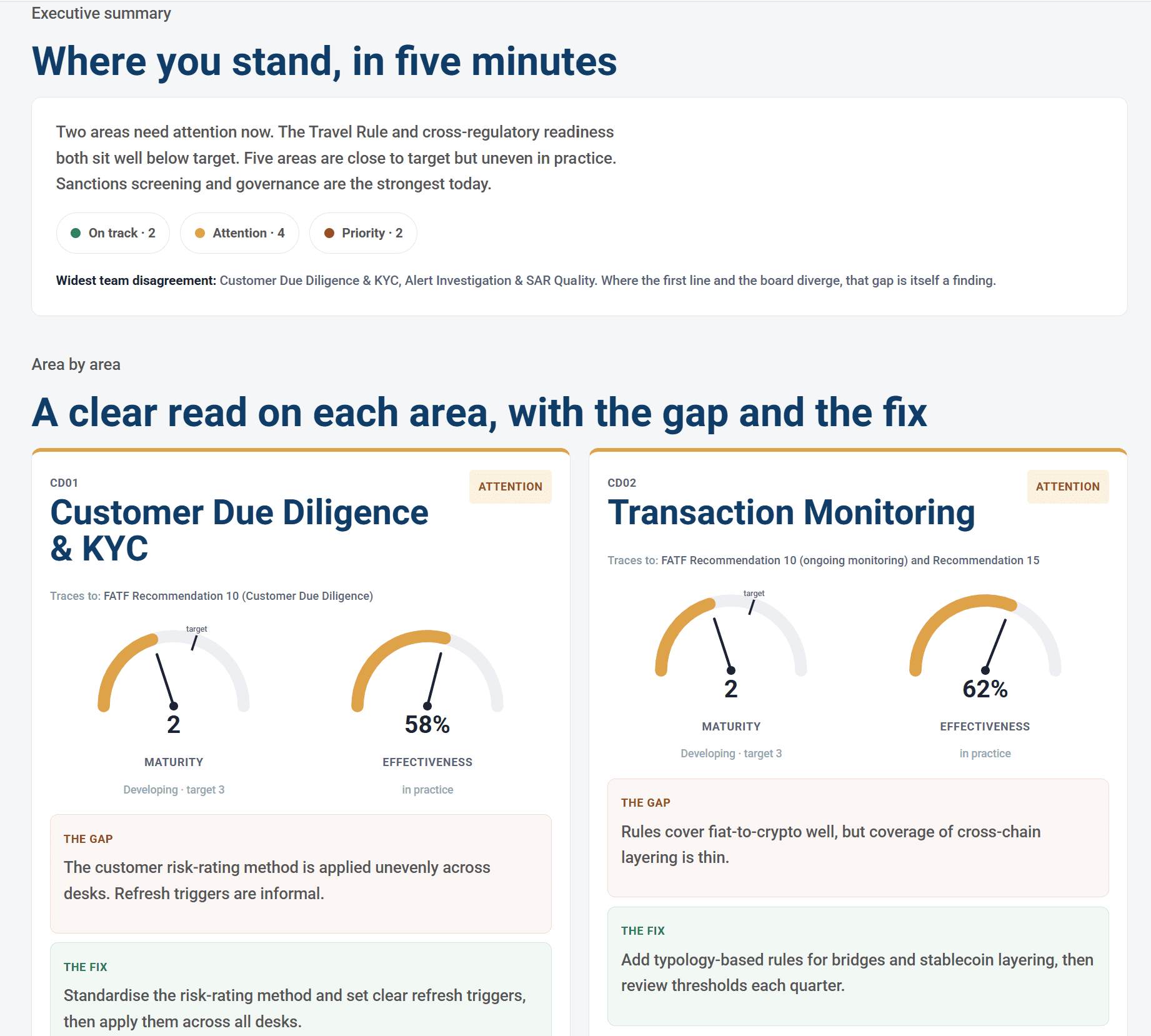
- Domain-level R/A/G. Each area carries a maturity colour, with a plain-English finding you can act on.
- Traceability pack. Findings map to the regulatory clauses they touch, so the thread is easy to follow.
- A 90-day roadmap. Organised as Now, Next, and Later, with owner roles and effort indicators. An executive summary sits on top.
How the Crypto Readiness Assessment Works
Most readiness checks ask one person to speak for the whole firm. Ours, however, works differently.
We read two things, not one.
Typically, a readiness check tells you only whether a control exists. Ours goes further, because it measures how developed each area is and then how well it works in practice. The first read shows what you have built. By contrast, the second shows whether it holds up day-to-day. Together, they separate the policy on paper from the control in use.
The "why" behind a gap, not just the "where".
Knowing where a control falls short is only half the answer. The harder question, therefore, is why it stalls. So we surface the human and cultural reasons behind each gap. Do people feel safe escalating a concern? Are controls seen as protection, or instead as a brake on the business? Those reasons ultimately shape the fix, so you treat the cause rather than the symptom.
A whole team's view, not a single voice.
Most checks rely on one person or a single workshop. Instead, we speak with six to ten people from across your business, who sit in four areas:
- Governance and oversight
- Risk and compliance
- First-line operations
- Third-party oversight
Naturally, different roles see different things, so comparing their answers makes the real picture visible.
In the end, you leave with a clear read on each area. In addition, you see the reason behind every gap. Finally, you get the right order in which to act.
Your timeline, day by day
- Day 1: We kick off, confirm the scope, understand your needs, priorities, and expectations, and book the interviews.
- Between days 2 and 10: We conduct the interviews with selected individuals across the relevant functions in your organisation.
- By day 12: We share draft findings and your traceability pack.
- Between days 14 and 21: We hold the readout call, set to your chosen pace.
You choose the pace. "Express", "Standard", and "Considered" timelines are all available.
Build Your Assessment
Pick your package, tier, and timeline. The deposit and balance update as you choose. Pay the deposit to start the engagement. Amounts are exclusive of VAT.
| Total fee (ex VAT) | £27,500 |
|---|---|
| Deposit when you click Buy Now (50%) | £13,750 |
| Balance on delivery | £13,750 |
| Creditable against onward work, within 60 days | £6,875 |
How ordering works
- Choose your package, tier, timeline, and any add-on jurisdictions above. The fee and deposit update as you choose.
- Check your selection before you pay. You can change any choice until you click Buy Now.
- Click Buy Now to pay the deposit on our secure payment page. You can review and correct the details there before paying.
- On payment, we email you an invoice and our terms. Together these form your contract, and you should keep them.
- The deposit is non-refundable, except where we fail to provide the service through our fault.
- The contract is concluded in English.
- We do not subscribe to a specific code of conduct.
Paying the deposit confirms acceptance of our Terms and Conditions for Online Purchases. A quarter of the fee is creditable against an onward engagement completed within 60 days.
Why Argus Pro for Your Crypto Readiness Assessment
Argus Pro is led by senior practitioners who have sat on both sides of a regulatory file.
As Principal Investigator, Vinay liaised with international law enforcement and regulators while leading a team of 120 consultants in the world's largest cross-border forensic investigation into an investment bank suspected of complicity in tax evasion. The investigation culminated in a $2.6bn fine for the bank.
Vinay's experience also includes helping a bank obtain a UK banking licence by demonstrating the maturity and effectiveness of appropriate controls.
Currently, Vinay is helping a large bank obtain authorisation for its crypto solution in the UK.
Our approach puts the regulation first. For example, for a global RegTech client seeking a global approach to crypto transaction monitoring, we built a 254-rule transaction-monitoring library anchored to FATF Recommendations, LRG from other key issuing bodies, and FATF, FinCEN, and EBA red flags.

Rules and controls anchor to FATF Recommendations, MiCA Articles, the UK's Money Laundering Regulations, the EU AML rules, and national requirements. They do not depend on any single blockchain analytics vendor. That is the difference between a score and a record a supervisor expects to see.
The Difference Between Compliant on Paper and Defensible Under Scrutiny
A RegTech client came to us with a brief for 40 transaction monitoring rules. When we showed them the regulatory landscape ahead, they made a different decision.
We delivered 254 implementation-ready rules, anchored to FATF and mapped to 12 regulatory bodies. Those rules were built to hold up under scrutiny, not just to satisfy a contract.
That is the distinction that matters when a regulator comes knocking.
Talk to Argus Pro About Your Crypto AML Controls
We can help in three situations. First, you are operating under a licence and want to show your controls work. Second, you are moving customers into a licensed entity. Or third, you are returning to the market and want to build it right.